Are We Natural Builders?
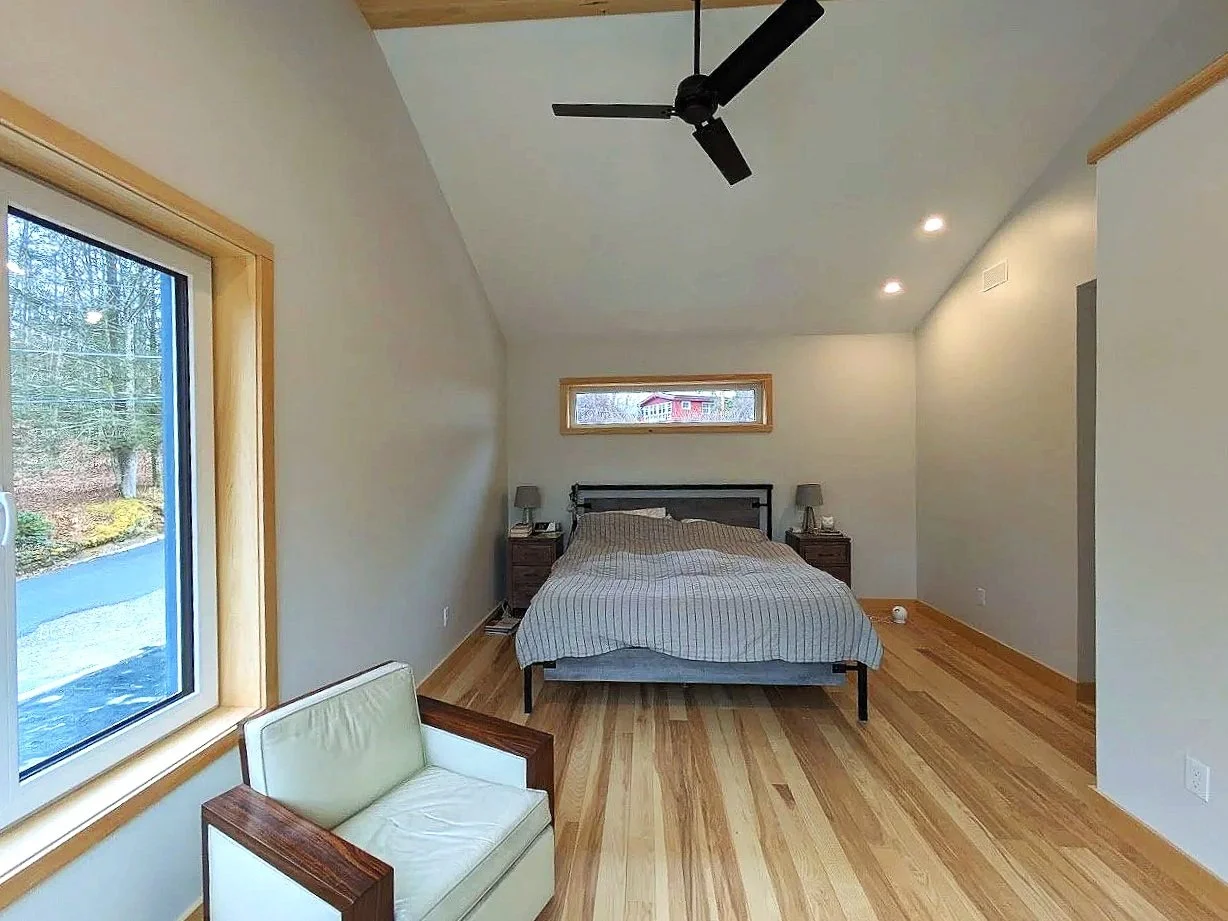
It's a question we get, implicitly, all the time. Someone visits a project, sees the clean lines and contemporary finishes, and their brow furrows slightly. "So... you use straw? But it doesn't look like..." They trail off, not quite sure how to finish.
What they mean is: it doesn't look like what they picture when they hear natural building. No exposed bales. No truth window. No rounded walls softened by hand.
They're right. And that's kind of the point.
The Label and Its Luggage
"Natural building" carries a distinct visual identity. It evokes structures that wear their materials openly — the warmth of cob, the texture of adobe, the rustic character of timber framing. These are beautiful traditions, and we have deep respect for them. They represent centuries of ingenuity and a genuine reconnective impulse: building closer to the earth, more honestly, with what's at hand.
But the label also carries expectations that can quietly work against the broader goal. If carbon-storing, biogenic construction is going to make a dent in the building industry's climate impact, it has to be something that architects specify, developers build, and buyers choose at scale. It has to fit, without apology, within the aesthetic and architectural norms that most people want to live inside.
That's the tension we sit in, and we think it's a productive one.
Yes, We Are Natural Builders. Here's the Nuance.
The straw in our Seed Panels is not a rustic gesture. It is high-performance insulation with an R-value that performs comparably with “conventional” assemblies, packed into a panelized structural system that our crews can stand up efficiently on a job site. The straw also happens to be carbon-negative, storing atmospheric carbon while it grew, and it will keep storing it inside the walls of a building for the life of that structure.
That's not incidental, it’s the whole idea.
So yes: we use bio-based materials. We are deeply committed to carbon-storing construction, healthy indoor air quality, and reducing the environmental harm that buildings cause. By those measures, we are absolutely natural builders.
But we are also high-performance builders. We design and build to net-zero standards. We operate within conventional architectural vocabularies. Our projects look like houses people want to live in — because we believe that's how this work gets replicated.
Defying the Aesthetic Expectation
There's a version of natural building that, however beautiful, remains a niche. The aesthetic limits its audience. And an approach to climate-forward construction that only appeals to a particular buyer, in a particular cultural moment, with a particular taste, is not going to move the needle.
We want straw in the walls of houses that look like the houses people dream about in Dwell magazine and on architectural tours. We want biogenic materials to be the default, not the exception — not because the aesthetic tradition of natural building isn't valuable, but because the materials themselves deserve to reach farther.
When someone walks into one of our finished projects and has no idea the walls are insulated with straw, that's not a failure of authenticity. That's the goal.
A Different Kind of Radical
Maybe the most radical thing we do isn't visible at all. It's in the assemblies, in the material sourcing, in the IAQ testing, in the carbon math. The radicalism is structural, not aesthetic.
We are natural builders. We're just not performing it for you.