The Hidden Costs Of Plastics in Construction
After writing about the hidden dangers of foam insulation, I started thinking more about the hidden costs of plastics at large, in life, and in the construction industry.
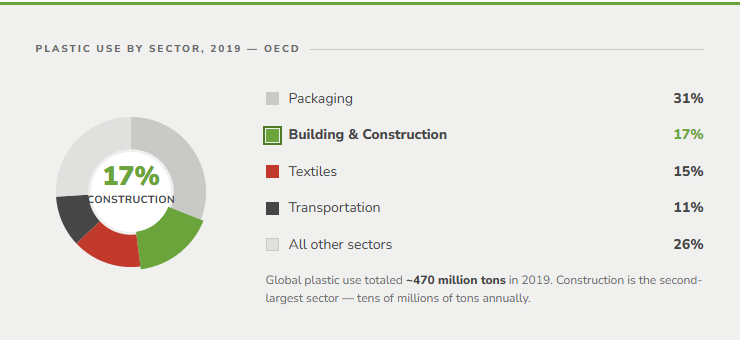
When you walk through any conventional construction site, you're walking through one of the planet's largest consumers of plastic. PVC, ABS, and PEX pipes running throughout the building. Vinyl siding wrapping the exterior. Nylon carpet, foam insulation, synthetic caulks, acrylic paints, polyester underlayments. The building industry accounts for 17% of all global plastics production, second only to packaging, yet most of those materials are selected without a second thought about their true cost.
That cost of this consumption is enormous, and it is almost entirely hidden from the line items on any project cost estimate.
For builders who have made the choice to work with bio-based materials like timber, hemp, cork, clay, wool, straw, this is old news. You already know, instinctively, that there's something wrong with wrapping a building in petrochemicals. But the scale of the problem, when laid out in full, is useful ammunition for client conversations, for specification decisions, for making the case to skeptical colleagues who keep reaching for the plastic because it's “cheaper”, or because it “works.”
It isn't cheaper. The price is just being paid by society.
What Are We Actually Paying For?
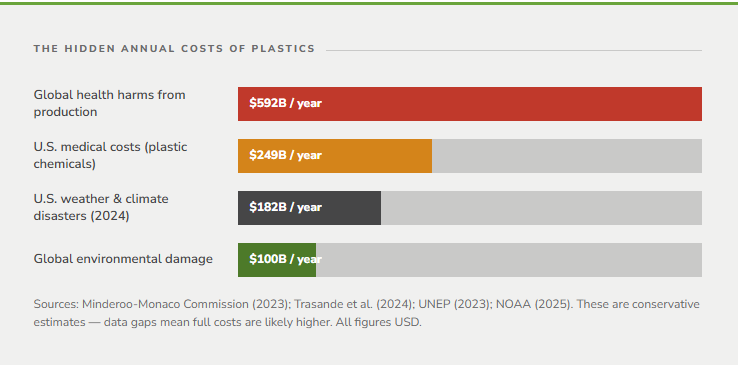
The sticker price of vinyl siding, PVC piping, or spray foam insulation reflects raw material costs, manufacturing, and a margin. It does not reflect the estimated $592 billion in global health harms caused annually by plastic production. It does not include the $100 billion in environmental damage racked up every year from plastic pollution. And it certainly doesn't account for the climate costs of a material that is, at its root, fossil fuel in another form.
The UN Secretary-General António Guterres puts it plainly: “plastics are fossil fuels in another form and pose a serious threat to human rights, the climate, and biodiversity.”
As the energy transition erodes demand for oil and gas in power generation, the fossil fuel industry has strategically shifted toward plastics manufacturing to maintain consumption. The International Energy Agency now projects petrochemicals will soon become the largest single driver of global oil demand. Every plastic product specified in a building project is, in a very real sense, a vote for continued fossil fuel extraction.
Then there are the subsidies. Globally, fossil fuels receive an estimated $7 trillion in annual subsidies from governments, effectively ensuring that plastic's feedstock is artificially cheap. The top 15 plastic-producing nations hand out roughly $30 billion in direct subsidies to the industry on top of that. In the United States, 32 plastic facilities built or expanded since 2012 have collected nearly $9 billion in state and local tax breaks. That's infrastructure for a more plastic-dependent world, funded by taxpayers.
When someone says the bio-based option "costs more," it is worth asking: more than what? More than a number that has been discounted by public subsidy? More than a material whose health and environmental costs have been externalized onto communities, ecosystems, and future generations?
The Building as a Slow Exposure Event
For those of us building for human health and comfort, the chemical dimension of plastic is especially important. More than 16,000 different chemicals may be present in plastic products. Over 25% of these are known to be hazardous to human health or the environment, and the majority of the rest simply haven't been adequately studied. These aren't abstract risks. They include chemicals linked to cancer, reproductive dysfunction, endocrine disruption, asthma, obesity, and developmental harm in children.
Buildings are not passive containers. They are dynamic chemical environments. Plastics embedded in a building continue to off-gas volatile compounds for years. Flexible PVC contains phthalate plasticizers that migrate into dust. Flame retardants added to foam insulation accumulate in household environments. Synthetic carpet releases a cocktail of compounds into indoor air. Occupants, especially children who spend the majority of their time indoors, are being continuously exposed.
Microplastics in the Built Environment
Most architectural paint is made with plastic. An eye opening moment for me was when I read last year that researchers estimate that paint, across architectural, marine, road, and industrial applications, is the single largest source of microplastic leakage into oceans and waterways, accounting for 58% of known sources. An estimated 4 million tons of plastic from architectural paint alone enters the environment each year. That's from a product applied to buildings.
Microplastics have now been found throughout the human body: in our blood, kidneys, hearts, and brains. Research published in 2025 confirmed their bioaccumulation in human brain tissue to the extent that we have the equivalent of a plastic spoon in each our our brains. We are only beginning to understand what this means for health, but the trajectory of the research is not reassuring. We know they accumulate. We know they are found in placentas and in the first stool of newborns. We know that babies are born pre-contaminated.
Buildings made with bio-based materials like timber, hemp, cork, natural plasters, wool insulation, simply don't contribute to this problem. There is no petrochemical chain to trigger. No plasticizer migration, no microplastic shedding, no off-gassing of hazardous additives. The building becomes a genuinely inert, breathable, healthy envelope rather than a slow exposure event.
The End-of-Life Problem Builders Don't Price In
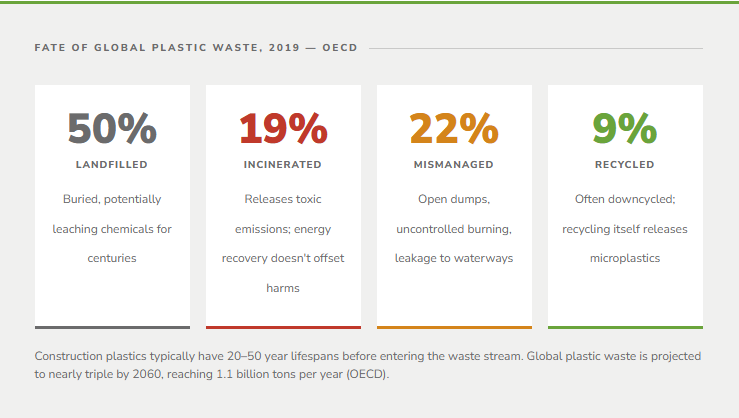
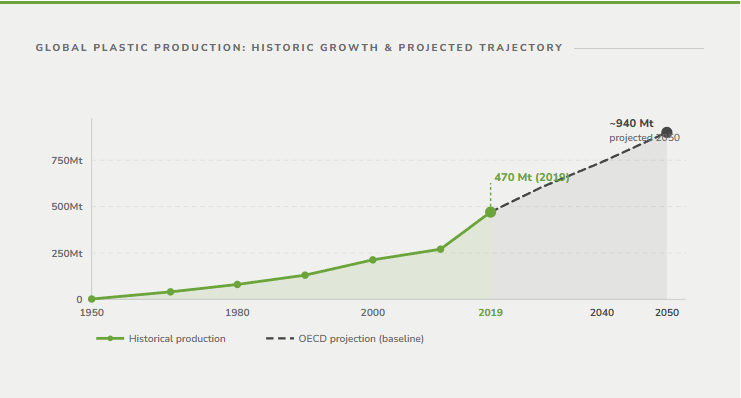
Plastic doesn't biodegrade. It fragments. A PVC pipe buried in 2025 will still be recognizable plastic in 2525 — it will just be accompanied by centuries of accumulated microplastic particles leaching into soil and groundwater. By 2060, over 543 million tons of plastic are projected to have accumulated in aquatic environments, including 160 million tons in the ocean.
Again, bio-based materials don't do this. Timber returns to carbon. Hemp fiber composts. Cork degrades. Wool breaks down. Natural plasters re-enter mineral cycles. At end of life, a bio-based building dematerializes gracefully rather than persisting as toxic legacy waste. This is a genuine competitive advantage — and it matters in a world where clients are beginning to think about embodied carbon, circular economy principles, and long-term stewardship.
Who Bears the Costs That Aren't on the Invoice
One of the most morally important dimensions of the plastic problem is its uneven distribution. The costs of plastic production are not borne by those who profit from it. They are borne by communities that live near petrochemical facilities, by children whose developing bodies are most vulnerable to chemical disruption, by Indigenous communities where plastic chemicals concentrate via air and ocean currents, and by low-income communities disproportionately sited near incinerators and landfills.
In Louisiana's "Cancer Alley", an 85-mile corridor between New Orleans and Baton Rouge lined with roughly 200 fossil fuel and petrochemical facilities, residents face elevated rates of cancer, respiratory disease, and reproductive harm. Two-thirds of the people living within three miles of the 50 newest plastic plants in the United States are people of color. The costs of cheap plastic are, to a significant degree, costs imposed on communities with the least political power to refuse them.
For builders who frame their work in terms of equity and justice, who care about who gets to live in healthy, comfortable, non-toxic homes, this dimension of the plastics problem is inseparable from the broader mission. The supply chain of plastic building materials runs through sacrifice zones. Bio-based supply chains, sourced from farms and forests, are not perfect, but they are a fundamentally different category of relationship with the land and with communities.
The Alternatives Are Ready
The most common objection to reducing plastics in construction is availability: "there isn't a bio-based alternative for everything." This is less and less true every year. For most common plastic applications in residential and light commercial construction, bio-based or lower-harm alternatives are available, often cost-competitive over a project's lifecycle, and frequently superior in terms of hygrothermal performance, vapor regulation, and occupant comfort. We work every day with the Seed Collaborative and the Bio-Based Materials Collective to increase the availability and visibility of bio-based alternatives.
The transition away from plastics in construction is already underway. Municipalities are implementing plastic reduction policies and altering their RFP's for building infrastructure. Major institutional buyers are revising their procurement standards. Material health certifications are raising the floor on acceptable chemical content. Builders who have already made the shift are not waiting for these trends, they are ahead of them, and they are building the vocabulary and the track record to bring clients along.
The hidden price of plastic is real. It's enormous. And someone is always paying it, even when it doesn't show up on the invoice.
Key Sources:
OECD. Global Plastics Outlook: Economic Drivers, Environmental Impacts and Policy Options. 2022. oecd-ilibrary.org
OECD. Global Plastics Outlook: Policy Scenarios to 2060. 2022.
Landrigan et al. The Minderoo-Monaco Commission on Plastics and Human Health. Annals of Global Health, 2023.
Trasande et al. Chemicals Used in Plastic Materials: Attributable Disease Burden and Costs in the United States. Journal of the Endocrine Society, 2024.
UNEP. Turning Off the Tap: How the World Can End Plastic Pollution and Create a Circular Economy. 2023.
Karali, Khanna, Shah. Climate Impact of Primary Plastic Production. Lawrence Berkeley National Laboratory, 2024.
Paruta et al. Plastic Paints the Environment. Environmental Action, 2022.
Environmental Integrity Project. Feeding the Plastics Industrial Complex. 2024.
Habitable. Plastics 101: Know the Costs. 2025. habitablefuture.org
McGrath, Stamm, Singla, Almroth. Buildings' Hidden Plastic Problem: Policy Brief and Recommendations. Habitable, 2024.
Wagner et al. State of the Science on Plastic Chemicals. 2024.